
Decifer Markets
Market intelligence
Decifer Markets turns market noise into a plain-English read on what is moving, why it matters and what to watch, across stocks, themes and catalysts.
Open MarketsOne team takes the project the whole way into daily use. Every system runs on your accounts, with a log your team can read.
Starts with a two-week assessment at a fixed fee, credited in full against any build.
Thirty years of pricing knowledge locked in one person's head. Turned into a quoting engine the customer runs themselves.
Live data arriving faster than anyone can read it. Eleven live streams ingested, cross-checked and written up as a decision brief, around the clock, unattended.
The same questions asked over and over, at all hours. An agent answers from live data, and refuses what it cannot verify.
The whole operation ran on one person's memory. Agents run it to a schedule, inside limits they cannot exceed.
Guidance that sounds right and is sometimes wrong. The model explains; the arithmetic decides what is correct.
Every company keeping its own numbers, none of them comparable. One set everyone reads, refreshed nightly, computed in code.
Skilled hours lost to intake paperwork. The admin runs itself, with no AI anywhere a client can meet it.
Seven industries, one method. Each block carries the service it was sold as and that service’s colour. Client work is named where the client has agreed in writing; our own products are named because there is nobody to ask.
Sixteen jobs arrive in no order and leave answered, priced and filed. Drag the orange line to change how much the system is allowed to work out for itself, and watch what it costs you at either end.
Steps where they work, judgement where they do not
16 of 16 handledoutput in order
Fixed steps do the parts that never change. Judgement is used only where the work genuinely needs it, agreed in writing before anything is built, and every number is still worked out and checked.
95%
of enterprise GenAI pilots produce no measurable P&L return.
MIT, The GenAI Divide: State of AI in Business, 2025
30%
of GenAI projects would be abandoned after proof of concept by the end of 2025, Gartner predicted, blaming poor data, weak controls, rising costs or unclear business value.
Gartner, July 2024
84% / 31%
In the GCC, most companies now use AI in at least one function. Fewer than a third have scaled it across the business.
McKinsey, The State of AI in GCC Countries, 2025
11%
of GCC organisations qualify as value realisers, able to attribute at least 5% of earnings to AI.
McKinsey, same study
The gap is in implementation, not technology. Everything below is how we close it.
Six failure points, and what we do about each.
None of these are model problems, so a better model does not fix them. Every Decifer engagement is structured against this list, starting with the baseline.
The pilot was chosen because the technology looked capable, not because anyone costed the process it replaces. When budgets are reviewed, there is no evidence to defend the spend.
We cost the process before any technology is chosen, so the spend can be defended at a budget review.
The workflow was designed around people, email and spreadsheets, and a model was bolted on top. The organisation gains another tool while the old work remains.
We redesign the workflow first, then automate the version worth keeping.
The demo ran on controlled inputs. Production needs the CRM, the inbox, the documents, the permissions and the history, and that is where scope and cost change.
The real systems go in early: the CRM, the inbox, the documents, the permissions and the history.
Real processes contain missing information and unusual cases. Nobody decided what the system handles, what a person reviews, and how a failed action is recovered.
The exception path is designed with you: what the system handles, what a person reviews, and how a failed action is recovered.
One invented figure in front of a customer, and the team quietly goes back to the old way.
Every figure is worked out in code, and the system will not publish one it did not calculate.
Time saved, cost reduced and response time all need a starting point. Without one, ROI becomes an opinion, and the project dies at budget time.
The baseline is the first deliverable, so the result can be measured against it later.
Three ways to stop doing the work.
You do not need to know which technology you want. You need to know how much of the job you would like to stop doing. Say that, and the rest is our problem.
Workflow automation
The jobs your team repeats every week get done without anyone doing them.
Right for you if
Bookings in a notebook. Quotes in email. The same report rebuilt every Monday. The business works, but it runs on people remembering things.
Your team gets its week back and spends it on the work only they can do.
Workflow automation with agentic AI
Everything above, plus one more pair of hands that talks to your customers and gets on with things.
Right for you if
The same questions arrive all day and half the night. Somebody has to answer them, chase the details and tie up the loose ends, and that somebody is expensive.
Your team keeps the work that needs them, and your customers get an answer whatever the hour.
Fully autonomous systems, a network of AI workers
A team of them, each holding a job, running the operation between them.
Right for you if
Work that never stops and should not need anyone awake for it. A product, a market, a channel that has to keep moving whether or not you are there.
The operation simply runs, and your attention goes where only you can go.
Most businesses start on the first and climb. Not sure which? That is what the first call is for.
Before we sell a method, we run it. Operating real products builds a discipline that demonstrations do not: real users, real data, model failures, infrastructure cost, monitoring and support. Decifer operates three public products built the same way we build for clients. They are not what this site sells. They are how we know the method holds.
5
months running every day with nobody operating it
Source: decifer-trading git history, first commit 2026-03-25. Verified 2026-08-22.
30+
jobs that run overnight so nobody has to remember to start them
Source: crontab, vercel.json and launchd files per repo. Verified 2026-08-22.
25+
business systems already connected: CRM, email, ads, payments
Source: integration clients per repo, deduplicated. Verified 2026-08-22.
9,000+
automatic checks that run before any change reaches a user
Source: decifer-trading tests/, counted 2026-08-22. Verified 2026-08-22.
Every figure above is listed with its source and the date it was last checked on how we count.
Market intelligence
Decifer Markets turns market noise into a plain-English read on what is moving, why it matters and what to watch, across stocks, themes and catalysts.
Open Markets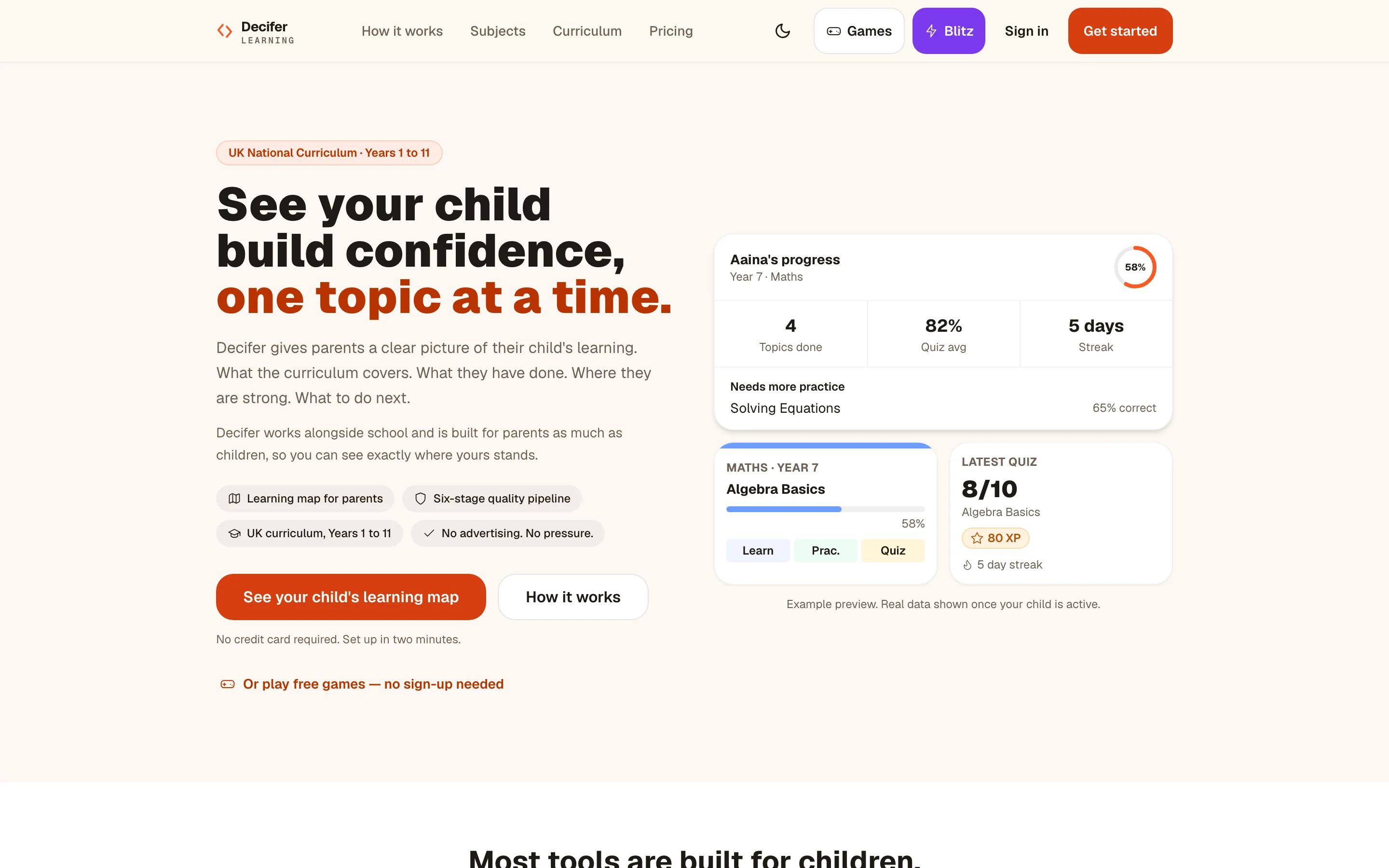
Learning intelligence
Decifer Learning is a guided companion for the UK National Curriculum. Children learn, practise and quiz through each topic while parents see real progress.
Open Learning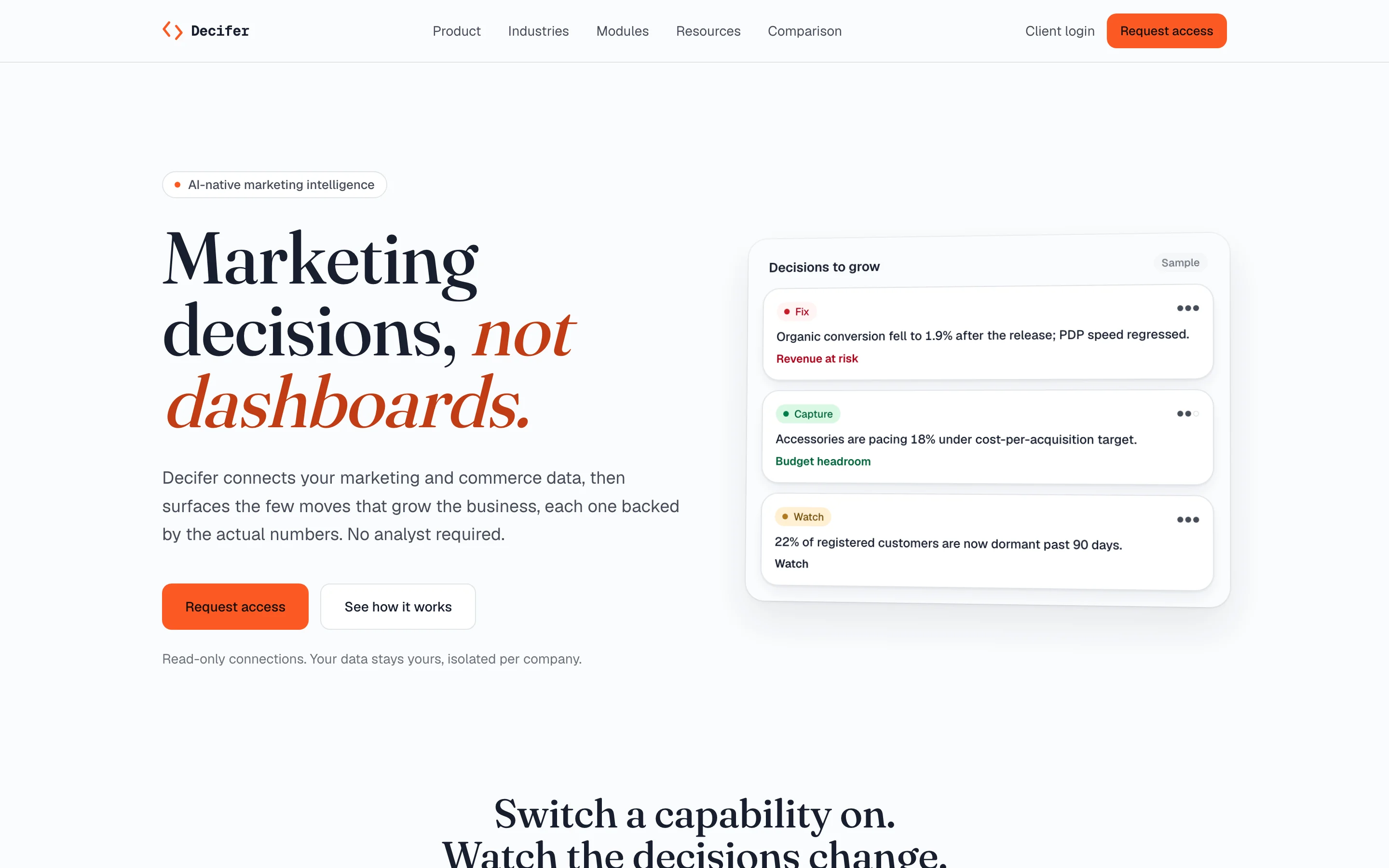
Marketing intelligence
Decifer Marketing turns campaign, channel and audience data into a plain-English read on what is working, why, and what to do next.
Open MarketingThe investing system trades a broker paper account. It has never submitted a live order and is not a real-money track record. We say this everywhere it is mentioned.
AI agent development
Two to eight weeks, then a retainer
We redesign the process, then build the system around it: agents scoped to one job, with limits you can see and a log you can check.
Scoped in writing
Human review where a mistake is expensive
Read the service
Data and reporting automation
One to eight weeks, fixed fee
Your data lands in one place you can query, including the data trapped in documents, and the reports assemble themselves from figures computed in code.
Fixed fee
Raw data exported to you
Read the service
AI product development
Six to twelve weeks, fixed fee
A complete product: website, database, logins, payments, email and analytics, built in weeks and handed over with the code.
Fixed fee
The repository transfers at handover
Read the service
AI consulting and assessment
Two weeks, fixed fee
A fixed-scope opportunity assessment that maps where time actually goes, costs the current process as a baseline, and tells you plainly what to automate first and what to leave alone.
Fixed fee
Credited in full against any build
Read the service
These are the four shapes an engagement takes. The twenty workflows we have already built sit inside them.
Discuss a business processDecifer. Dubai, UAE.
I started Decifer because businesses are drowning in information and short of understanding. The first answers were our own products. Running them in production taught me what it takes to keep AI working after the demo, and other businesses began asking for the same thing.
I am in Dubai, I read every enquiry myself, and I will tell you when AI is the wrong answer. Sometimes the fix is a spreadsheet formula and one fewer approval step.
Decifer helps companies implement AI inside real business processes. We identify the opportunity, redesign the workflow, build the system, connect the tools you already run, establish operating controls and measure the result. We also build and run three public products of our own, which is where the method is tested.
With a process where the outcome can be measured: repeated manual work, high volume, slow response times, fragmented information, or decisions that keep needing the same context. The two-week assessment ranks these before anything is built, at a fixed fee credited in full against any build that follows.
Often, yes. The assessment works on an existing pilot as well as a new idea. We baseline the process, find the point it stopped at, and set out the shortest route from there to something running daily.
Yes. Most of the work involves existing environments. We assess the available APIs, databases, documents and permissions before deciding how the implementation connects to them.
Yes, where the workflow benefits from one. Where plain automation or a simple lookup does the same job, we build that instead: it costs less every month and your team can own it. We have made that swap 5 times in our own systems.
We design around them. Figures are checked against what the code calculated, actions are limited to what the job needs, a person reviews anything expensive, every step is logged, and unusual cases have a route out. The system will not publish a number it did not work out. How tight the controls are depends on what a wrong answer would cost you.
The baseline is taken before implementation: employee time, processing cost, turnaround, error rate, conversion or another operating measure. After deployment the same measures are read again, the same way. Without a baseline, ROI is an opinion.
You do. Every account is opened in your name, the repository transfers to you at handover with a runbook, and the data lives in standard Postgres you can export. Ongoing support is a commercial choice, never a technical trap.
Where a client has agreed in writing to be named, yes. Otherwise we describe work by sector and shape, with what we built, what changed, how it is measured and where a person stays in charge. Your project would be treated the same way. Figures are published only with the method and written permission.
Thirty minutes on the process you want to improve. You will know what the right solution looks like, what it would take to build, and what it should return.
Replies come from a named person in Dubai within one working day.